Norwalk, CT · Garage Door Service
Spring Repair for Ridgefield Garage Doors
Spring repair for Ridgefield's 1970s-era garage doors. Norwalk Garage Door Pros runs the 16-mile job from Norwalk out to town - here's what it actually involves.
- Repairs & new doors
- Springs & openers
- Serving 8 nearby communities
The Cost of This Job
We don't have a Ridgefield-specific price list to hand you here, and we're not going to make one up. What we can tell you is what drives the number on any spring job: whether it's one spring or two, the door's weight and width, and whether the drums or cables need to come off while we're in there. Houses in this part of town went up around 1973, median year, which means a lot of the doors still running are either original hardware or a straightforward second-generation torsion setup - not the oddball extension-spring jobs you find on older or much newer stock. That keeps parts predictable, which keeps the quote predictable too. We'll give you a real number once we've looked at the door, not before.
One honest note: if the drums, bearings or track are also shot, a spring swap stops being a spring swap and turns into a bigger repair. We'll tell you straight if that's where you're headed instead of quoting a spring price and letting the rest surprise you later.
How It Shows Up
The door won't open, or it opens about six inches and stalls. Sometimes it's a loud bang from the garage - that's the spring letting go, not the opener. On a double door, one spring often fails while the other holds, so the door comes up crooked, higher on one side, before it jams.
On houses from Ridgefield's 1973 median build year, we also see the slower version: the opener groans for a few weeks, strains harder each time, before the spring finally lets go on its own. That's a fatigued spring, not a mystery. Ignore it long enough and it takes the opener's drive gear with it.
Why It Happens Here
A torsion spring is rated for a set number of open-close cycles, somewhere around 10,000, and once it's there, it's there - it doesn't matter how carefully the door's been used. Most of Ridgefield's housing stock sits right around that 1973 median, and a spring that's been on the door since it was built is well past any reasonable cycle count, original or not.
Cold makes it worse. Steel contracts in winter, and a spring that's already near the end of its life is more likely to snap on a cold morning than a mild one. With 9,237 households in town, a good share of them are still running the torsion hardware that came standard through the 1970s and into the early '80s - the same window that produced the original springs now reaching failure age across the area.
What the Repair Takes
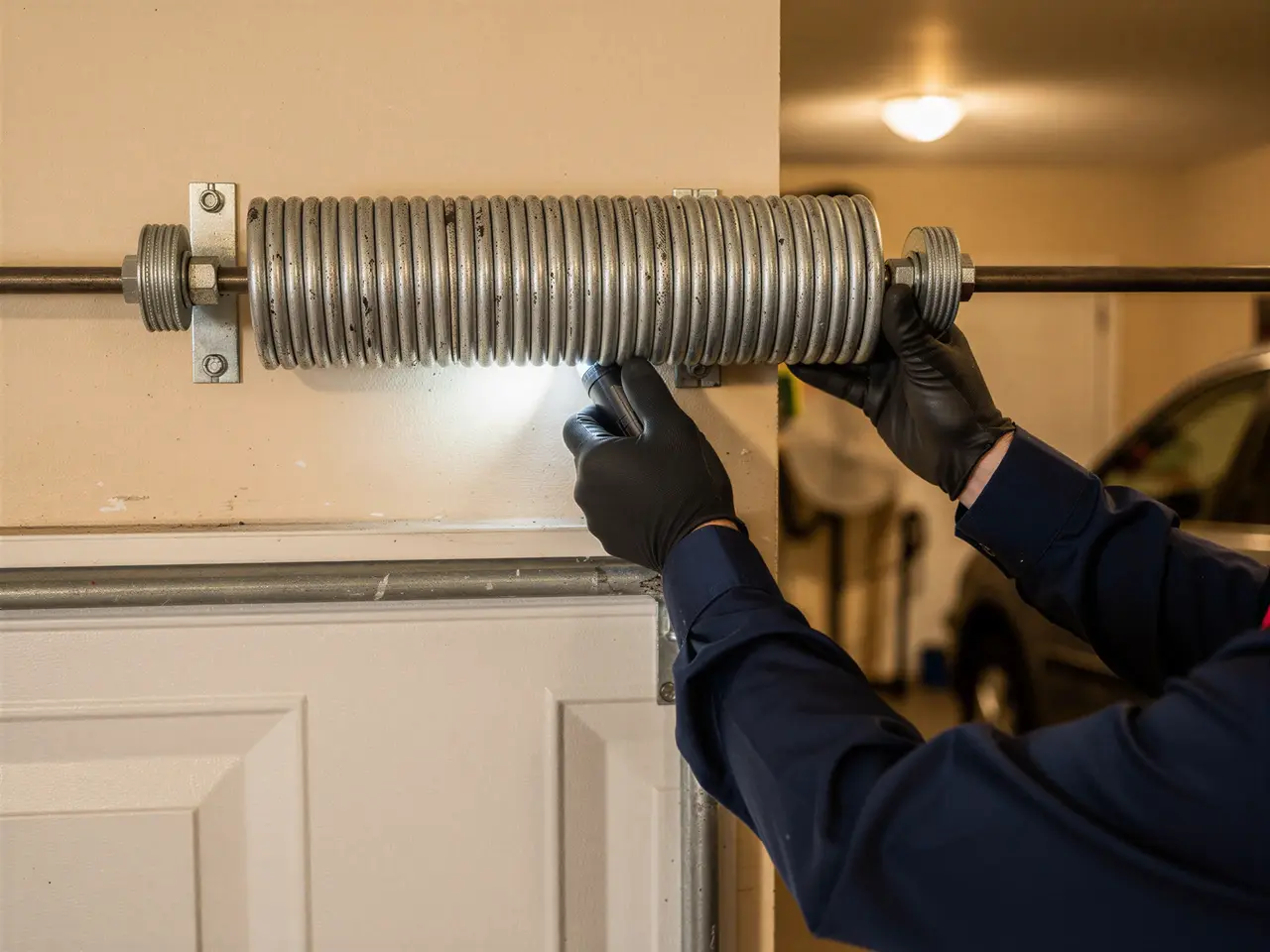
We match the spring to the door - wire size, length, and wind direction all have to be right, not close. On a double door we replace both springs even if only one broke, because the second one is the same age and on the same clock. We check the drums, cables and end bearing plates while the spring's off, since that's the only time they're easy to get at.
We travel the 16 miles out from Norwalk for this, so we're scheduling a visit rather than rolling a truck that's already a few doors down. That's not a complaint, just how the coverage works for Ridgefield - we're not based in town, and we won't pretend otherwise.
Can You Do This Yourself
We'd rather you didn't. A wound torsion spring stores enough force to break a hand or worse if the winding bars slip, and the tools for it aren't something most garages have sitting around. If you're the kind of homeowner who wants to understand the job before someone else does it, fine - know that the spring size has to match the door's weight and the drum size, and that getting it wrong either burns the opener out early or leaves the door dangerously unbalanced.
What you can safely do yourself: pull the emergency release, check if the door's hand-liftable and roughly balanced at the midpoint, and have that information ready when you call. It saves time on the visit and tells us a lot about what's actually failed.
What Can Go Wrong
The spring isn't always the whole story. On a door that's been running on a tired spring for a while, the opener's drive gear or capacitor can go at the same time, and a cable can jump the drum if it was already fraying. We check all of it before we call the job done, because replacing the spring and leaving a bad cable in place just means a second call later.
Occasionally the door itself is the real problem - enough rust or panel damage on an older unit that the honest answer is replacement, not another repair. We'll say so if that's the case instead of patching a door that's not worth patching.
Frequently asked questions
How old does a spring usually get before it breaks in a Ridgefield house?
It depends on use, but torsion springs are rated for roughly 10,000 cycles. On houses built around Ridgefield's 1973 median, original or early-replacement springs are often well past that count, which is why failures cluster on older hardware rather than newer doors.
Do you carry spring stock on the truck for a Ridgefield call?
We don't have a parts inventory list to share here. What we can say is we travel the 16 miles from Norwalk for these jobs, so we come prepared based on what you tell us about the door before we head out.
Why did both springs break on my double door?
They usually don't break at once - one goes first, but if the door's original, both springs are the same age and have logged the same cycles. We replace both together on a double door so you're not back to square one in a few months.
Is it ever cheaper to replace the whole door instead of the spring?
On a door with a failed spring but sound panels and track, repair almost always wins. It only tips toward replacement when the door itself has rust, warping, or damage bad enough that fixing the spring wouldn't actually fix the door.
More garage door services in Ridgefield
Book garage door service in Norwalk
Call now or request a quote - tell us what the door is doing and where you are.