Norwalk, CT · Garage Door Service
Garage Door Repair for Ridgefield's 1970s-Built Homes
Ridgefield homes built around 1973 carry original steel doors and torsion hardware now at end of life. We drive the 16 miles from Norwalk to fix what that era left behind.
- Repairs & new doors
- Springs & openers
- Serving 8 nearby communities
The Cost of This Job
What a repair runs in Ridgefield depends on what's actually failing, and that's shaped by when the house went up. Most of this town's housing dates to around 1973, which puts it a few years past the broader 1955-1984 band that covers the rest of the service area. A door from that build year is usually a single steel panel on a torsion spring mounted above the opening, not the two-spring extension setups you'd find on an older cape. Replacing a spring on that hardware is a different job, with different parts, than replacing a cable drum or a worn roller track. We don't quote a number without seeing the door, because a $200 spring job and a $1,200 full-unit swap both start with the same phone call and the same symptom: the door won't move. What we can tell you is that 9,237 households in Ridgefield are sitting on roughly the same age of door, so if yours is original, it's not an outlier - it's due.
How It Shows Up
The door gets loud before it quits. A torsion spring on a 1970s single-car or double-car steel door starts making a scrape or a thud on the way up as the coils lose tension unevenly, and the opener starts straining - you'll hear the motor work harder for the same lift it used to do without effort. Sometimes it's not the spring at all but the track pulling away from the frame where the original lag bolts have backed out over fifty years of seasonal expansion. Either way, the door usually doesn't fail all at once. It gets harder to trust for a few weeks first, then one morning it doesn't come up.
Why It Happens Here
Connecticut's cold-severe climate band means fifty winters of hard freeze-thaw cycles on steel hardware, and Ridgefield's housing stock has had close to that many. A door and torsion spring installed when the house was framed in 1973 has been through five decades of that cycling, and steel fatigues under repeated cold-weather tension whether or not anyone's touched it. Original installs also used the hardware standards of their day - lighter-gauge torsion springs, smaller-diameter shafts - built for a different expected lifespan than what a homeowner assumes from a door that still looks fine. The paint holds up. The spring doesn't.
What the Repair Takes
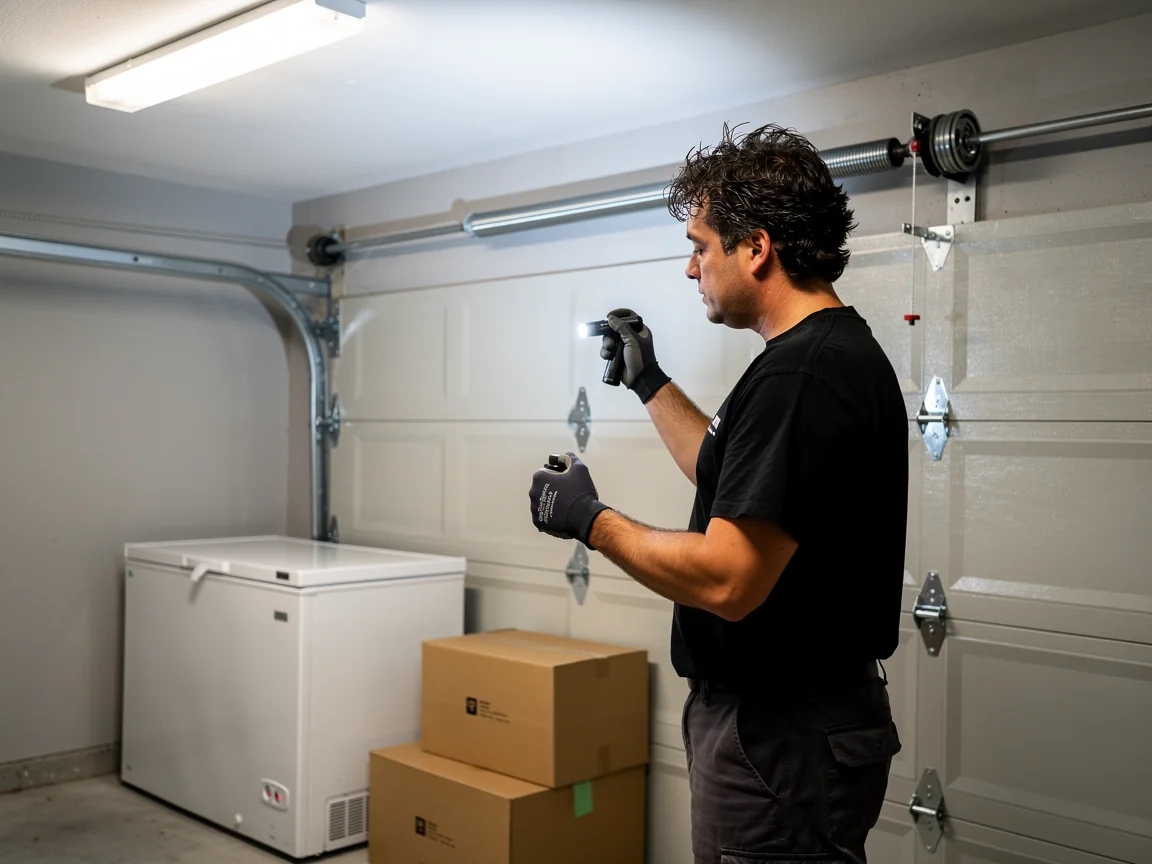
For a torsion spring on a door this age, the job is removing the old spring under controlled tension, matching wire size and wind to the door's weight, and resetting the drums and cable before testing travel and balance. If the track or hinges have moved with the frame over the years, that gets straightened or replaced at the same visit rather than left to fail next. We carry common spring sizes on the truck, but some older or oversized commercial-grade springs aren't stock items everywhere, and if yours is uncommon we may need a day to get the right one rather than force a mismatch that throws the door's balance off again in a year.
Can You Do This Yourself
A torsion spring holds enough stored tension to break a hand or worse if it lets go while you're working on it, and that risk doesn't go down because the door is old - it goes up, since fifty-year-old steel is more likely to snap than release cleanly. Lubricating hinges, tightening visible bolts, and clearing track debris are fine DIY jobs. Pulling or winding a spring, or working on the cable drums while the door's off its tracks, is not something we'd recommend without the right bars and clamps. If you're not sure which category your fix falls into, that's a reasonable thing to ask us on the phone before you start.
What Can Go Wrong
The failure we see most in houses from this era is a cable that's jumped the drum because the drum itself has worn an uneven groove over the decades, and nobody notices until the door comes down crooked. Left alone, that usually bends the track on one side, which turns a cable job into a track-and-cable job. The other one is an opener from a later retrofit fighting a spring that's lost tension - the opener motor does the work the spring should be doing, burns out early, and gets blamed for a problem that started in the hardware above it. Catching the spring issue first is cheaper than replacing the opener twice.
Frequently asked questions
Why does my door's hardware look original but still fail?
Steel doesn't show fatigue the way wood does. A torsion spring installed when Ridgefield's housing stock went up around 1973 can look fine right up until it loses tension or snaps, because the failure is internal to the metal, not visible on the surface.
Do you have a shop in Ridgefield?
No - we're based in Norwalk and drive out to Ridgefield, about 16 miles each way, for service calls. There's no local branch or depot here, just the truck coming from Norwalk.
Is it worth repairing a door this old or should I replace it?
Depends on what's failing. A spring or cable repair on sound panels and track is usually worth it. If the track's bent in multiple places or the panels are rusted through, replacement often costs about the same over time as repeated patch repairs.
More garage door services in Ridgefield
Book garage door service in Norwalk
Call now or request a quote - tell us what the door is doing and where you are.