Norwalk, CT · Garage Door Service
Garage Door Repair in Norwalk, Built Around What's Actually on Your House
Garage door repair for Norwalk CT homes built mostly between 1955 and 1984, where original torsion hardware meets severe cold winters. Call for a straight diagnosis.
- Repairs & new doors
- Springs & openers
- Serving 8 nearby communities
What the Repair Takes
A repair call in Norwalk almost always starts with a question: is this hardware original to the house or has it been swapped once already. A lot of houses in this service area went up between 1955 and 1984, median build year around 1968, which puts a huge share of doors on their second or third spring but their first track system. That matters because a repair on 1960s-era track geometry isn't the same job as a repair on a door installed last decade. The bracket spacing is different, the header clearance is tighter, and the drum sizing on older torsion setups doesn't match what's stocked for new installs.
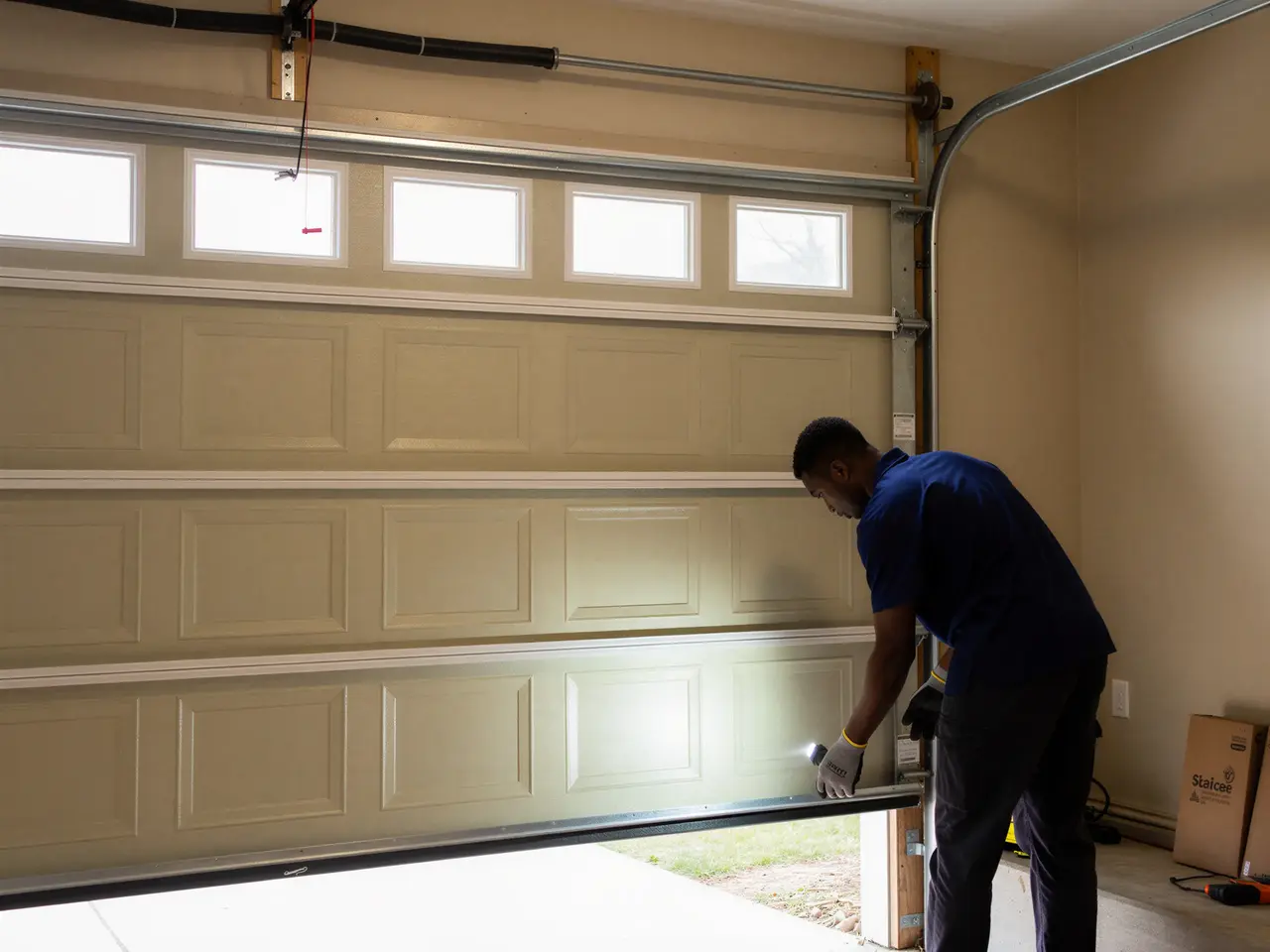
We diagnose before we quote. That means checking the spring wind, the cable wear at the drum, the track plumb at both jambs, and whether the opener is actually the point of failure or just the thing that stopped working because something upstream of it failed first. On a door that's been limping for months, sometimes the honest answer is that a repair buys you another year and a new door is the better money. We'll tell you that straight rather than stack parts onto a door that's done.
What we won't do is quote a repair over the phone with no eyes on the door. Spring tension and track wear don't describe well in a text message, and guessing wrong on a torsion spring is how people get hurt.
What Is on the Truck
Because so much of Norwalk's housing dates to that 1955-1984 window, the truck carries torsion springs sized for older drum diameters, not just current stock sizes. Original one-piece and sectional doors from that era often ran on hardware that newer parts don't drop into without an adapter plate, so we keep those on hand rather than making a second trip.
We stock standard-lift cables, rollers in both nylon and steel, and a range of torsion springs because wind count and wire gauge vary more across a 1960s-70s housing stock than people expect. Openers get carried in common chain and belt-drive configurations, since most failures we see are a burned-out motor or a stripped gear, not a bad logic board.
The honest limitation here: some original hardware from the oldest end of that build range is genuinely obsolete. If a part was discontinued decades ago and the drum or shaft is a non-standard size, we may need to order it rather than carry it, and that can mean a short wait instead of a same-visit fix. We'd rather tell you that up front than pretend every 1960s door has a drop-in modern replacement sitting in the truck.
Why It Happens Here
Norwalk sits in a climate band classified as severe cold, and that's the piece people underestimate. Steel panels and galvanized track contract in winter cold enough to bind rollers that ran fine in August, and torsion springs lose a measurable amount of lifting force in deep cold, which is why so many spring failures cluster in the coldest stretch of the year rather than spreading evenly across twelve months.
Pair that climate with a housing stock where a large share of doors are original or near-original to a 1955-1984 build, and you get a specific, recurring failure pattern: hardware that was never designed for the fatigue cycles it's now on its fourth or fifth decade of absorbing, meeting a cold snap that tightens tolerances right when the steel is already tired.
Across the service area there are roughly 70,601 owner-occupied houses out of 106,487 households, and the majority of calls we get involve a door that's lived its whole life on one street, never replaced, just patched. That's not unique to any one block - it's the pattern across a housing stock that's mostly 1960s and 70s vintage, which is most of what's standing here.
How It Shows Up
The most common version: a door that worked fine the night before and won't lift at all in the morning, usually after a cold overnight stretch. That's almost always a torsion spring that let go under the combined load of age and contracted steel - not an opener problem, even though the opener is what people blame first.
Second most common: a door that lifts but grinds or shudders partway up, which points to roller wear or a track that's pulled slightly out of plumb over decades of seasonal expansion and contraction. On older builds this shows up more at the top section, where the original track brackets have loosened a fraction at a time over forty-plus years.
Third: an opener that runs but the door doesn't move, which is a disconnected or worn drive component, not the motor itself in most cases.
Median household income across this service area runs around $168,810, and at that income level we see fewer owners patching a dying spring repeatedly and more choosing a full hardware replacement once a second failure shows up on the same door - they'd rather close it out than keep calling.
Frequently asked questions
Why did my garage door spring break overnight with no warning?
Torsion springs lose lifting force in cold weather, and a lot of Norwalk's housing stock is running original or near-original hardware from the 1955-1984 build era. A spring that's been fatiguing for decades often lets go during a cold stretch, not gradually - it looks sudden but it's been building for years.
Is it worth repairing a door from a 1960s-era house or should I replace it?
Depends on what's failing. If it's a spring, cable, or roller issue on an otherwise sound door, repair usually makes sense. If the track geometry is worn out or the panel itself is rusted through, a repair just delays a replacement you'll pay for anyway. We'll tell you which situation you're in before we quote anything.
Do you carry parts for older torsion hardware on the truck?
Most of it, yes - we stock springs and cables sized for the drum and shaft dimensions common in Norwalk's 1960s-70s housing stock. Some of the oldest, discontinued hardware isn't something we carry standard, and that can mean a short order wait instead of a same-day fix.
Why do garage door repair calls spike in winter here?
The climate here is classified as severe cold, and steel contracts enough in that cold to bind tracks and reduce spring tension on hardware that's already decades old in a lot of houses. The two factors compound, which is why winter is when a lot of doors finally fail.
Related services
Related guides
By Neighborhood
Garage Door Repair across the Norwalk area
We also handle garage door repair in these Norwalk-area suburbs.
Book garage door service in Norwalk
Call now or request a quote - tell us what the door is doing and where you are.