Norwalk, CT · Garage Door Service
Spring Repair for Westport Garage Doors
Spring repair for Westport's 9,698 households, mostly built around 1968. Torsion springs rated for Connecticut winters, serviced from our Norwalk shop 4 miles away.
- Repairs & new doors
- Springs & openers
- Serving 8 nearby communities
What Is on the Truck
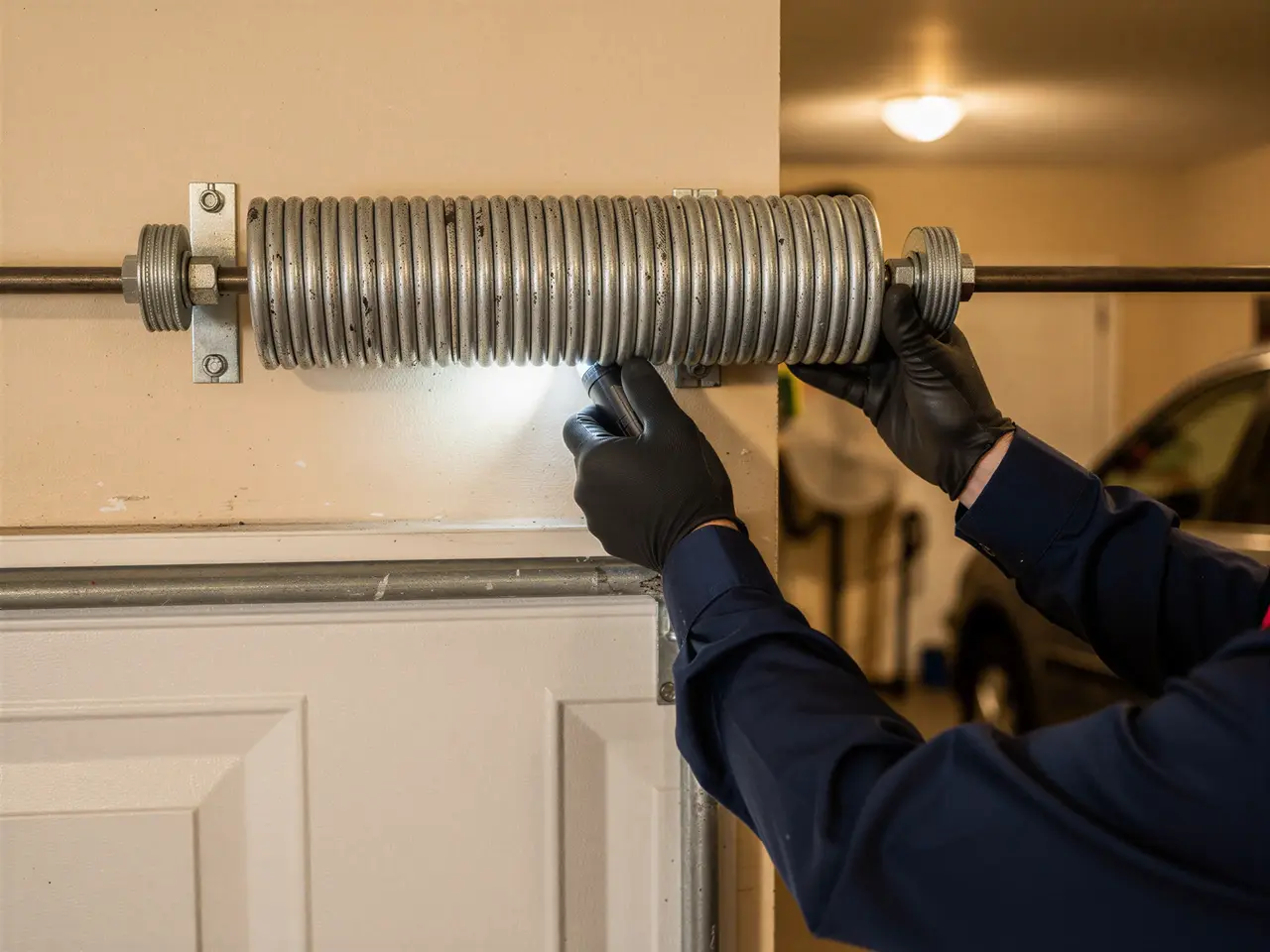
Westport is a town of 9,698 households, which is a small enough number that the spring sizes we carry don't vary much job to job. Most of the stock here went up around 1968, during the same mid-century building wave that shaped the rest of this part of the county, so the torsion springs we pull off the truck are sized for the same handful of door weights over and over: standard steel sectional doors on torsion hardware, not the older extension-spring setups you'll find in some much older housing stock.
We carry torsion springs in the wind and wire gauges that match that era's door weights, plus the winding bars, cones, and safety cables to do the swap correctly. Connecticut's winters sit in a cold-severe climate band, and repeated freeze-thaw cycles work steel fatigue faster than a mild climate would, so we also carry a range of cable and roller stock, since a tired spring often means a tired cable too.
What we don't carry is custom millwork or anything built to match a specific architectural door face. If your door is a higher-end custom unit, we can usually still fix the spring, but matching trim or a replacement panel is a separate conversation.
Can You Do This Yourself
A torsion spring is wound under enough tension to break a wrist or worse if the winding bar slips, and that risk doesn't change because the house is nice or the town has a high median income. What does change job to job is how long the spring has been under load. Doors on original 1960s-era torsion hardware have had roughly sixty years of cold-severe winters to work the steel, and that kind of long-term fatigue can make a spring let go with less warning than a newer one.
If your door won't open, the spring is likely already broken and the opener is straining against a dead weight, in which case the safest move is to stop using the opener entirely. If the spring is intact but the door feels heavy or uneven, that's a sign it's close to failing, not something to lubricate and wait out.
We're honest that this isn't a project for a homeowner with a socket set and a video. The tools for a safe torsion spring swap, the winding bars sized to the cone, and the experience to read how a spring is failing before it fails, aren't things worth improvising for a repair this dangerous.
What Can Go Wrong
Westport's housing is mostly original to the 1955-1984 building wave, with a median year of 1968, which means a lot of doors here are still running the torsion springs and cones that came with the house. That hardware wasn't built to last indefinitely, and in a cold-severe climate the metal fatigues faster through repeated winter contraction than it would somewhere milder.
The most common failure we see on houses this age is a torsion spring that's simply worn out from decades of cycling, not a dramatic snap but a slow loss of lift until the opener starts straining. Close behind that is a cable that's frayed from running over a worn drum for years without anyone noticing, since the spring and cable usually age together.
Less common, but worth knowing about: on some of the older double-door setups from this era, both springs are matched as a pair, and replacing just one leaves a mismatch that throws the door off-balance within a few months. We replace springs in pairs on double doors with shared hardware when the second spring is close to end of life, even if it hasn't failed yet.
Booking a Visit
We cover Westport from our shop in Norwalk, about 4 miles away, as part of the same route that runs through the rest of this side of the county. There's no Westport branch or separate crew - it's the same truck and the same technicians who handle calls across the service area, so what you get here is the same repair, not a scaled-down version of it.
When you call, tell us the door's rough age if you know it and whether it's a single or double door. Since most homes in town are from the 1960s-70s wave, that alone tells us a lot about what hardware to expect before we even arrive, which saves time on-site.
See our Westport coverage page for the towns around it we also serve, or the Norwalk spring repair page for the fuller rundown of how we handle spring jobs generally.
What the Repair Takes
Most torsion spring jobs on the standard sectional doors common to this town's 1960s-70s housing stock are a same-visit fix: pull the old spring, size and install the new one, balance the door, and check the cable and rollers while we're in there. Doors from this era are mechanically simple compared to some newer high-cycle or insulated models, which actually makes the repair more predictable, not less.
Where it takes longer is when the spring failure has already damaged something downstream - a bent track from a door that dropped unevenly, or a cable that let go and let the door fall. Those add parts and time.
One honest limitation: if your door is an older extension-spring design rather than torsion, or a less common size, we may need to order the exact spring rather than have it on the truck, which can push the job to a second visit. We'll tell you up front if that's the case rather than mid-repair.
Frequently asked questions
Why does my spring keep failing faster than my neighbor's house in a different town?
It usually comes down to age and climate, not luck. A lot of Westport's housing dates to around 1968, so many original torsion springs have had decades of cold-severe Connecticut winters cycling the steel. Fatigue builds up over years of freeze-thaw, and once a spring is near the end of its life, it can go without much warning.
Do you keep a crew based in Westport?
No. We run out of our Norwalk shop, about 4 miles from Westport, and cover this town as part of our regular route. You get the same technicians and the same spring stock as any other stop on that route, not a separate local setup.
Is it worth replacing both springs on a double door if only one broke?
Often, yes, especially on older double-door setups from the 1960s-70s where both springs were matched as a pair. If the second spring is close to the same age and wear as the one that failed, leaving it in place usually means a second failure within months and an unbalanced door in the meantime.
Book garage door service in Norwalk
Call now or request a quote - tell us what the door is doing and where you are.